.png)

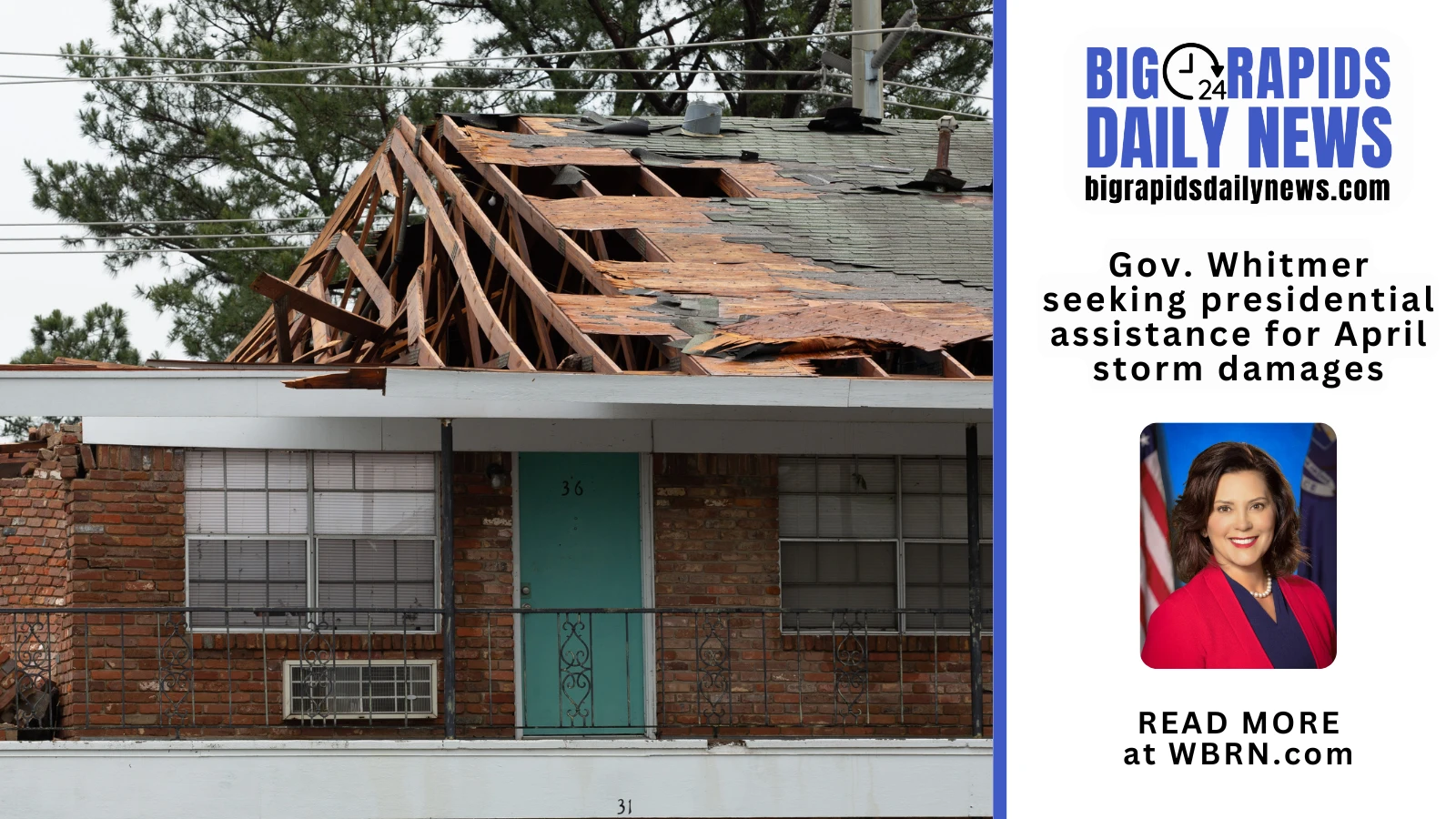
On Friday, June 5, Gov. Whitmer requested that President Trump declare a major disaster in response to severe storms, heavy rain, rapid snowmelt and nine confirmed tornadoes that caused widespread damage and severe flooding in 43 counties across Michigan between April 10 and 21.
If approved, the governor’s request would allow federal aid to start flowing directly to families, businesses, and communities.
“The severe storms, flooding and tornadoes that struck Michigan in April left a devastating impact on communities across more than half of the state, destroying and damaging homes, businesses, and roads,” said Whitmer. “While recovery efforts are underway, many residents and local governments face difficult and costly challenges. This request for a major disaster declaration will help ensure affected families and communities have access to the resources they need to recover, rebuild and move forward.”
The requested activation would apply all the Federal Emergency Management Agency’s (FEMA) Individual Assistance (IA) programs for 37 counties, including these local counties: Clare, Lake, Mecosta, Missaukee, Montcalm, Newaygo, Osceola, and Wexford. Individual assistance programs would direct help for homeowners and renters.
All categories of the Public Assistance (PA) program have been requested for 26 counties, including these local counties: Lake, Mecosta, Missaukee, Newaygo, Osceola, and Wexford. The PA program works as reimbursement for local governments, certain non-profit entities, and tribal agencies for response costs, debris removal, and repair of damaged infrastructure
Multiple rounds of severe thunderstorms and heavy rainfall between April 13 and 18 produced tornadoes, damaging winds, large hail, flash flooding and major river flooding across much of Michigan. Hundreds of residents were displaced or stranded by floodwaters, numerous roads were flooded or washed out, and several dams required close monitoring due to overtopping and failure concerns. During April, the National Weather Service issued a record 13 flash flood warnings, 24 flood warnings and 25 flood advisories across Michigan. While floodwaters have largely receded, recovery efforts remain ongoing as some homeowners are still dealing with the lasting effects of floodwaters.
“The scale and severity of this disaster demanded an unprecedented damage assessment effort involving local, state and federal partners,” said Col. James F. Grady II, director of the Michigan State Police and state director of Emergency Management and Homeland Security. "Federal disaster assistance is vital for community recovery, enabling the restoration of essential services and the rebuilding of homes and infrastructure."
To evaluate eligibility for a major disaster declaration, the State of Michigan conducted its largest Joint Preliminary Damage Assessment (PDAs) to date with FEMA and the U.S. Small Business Administration (SBA). These assessments determined that the extent of damage met federal thresholds for a Major Disaster Declaration.
Here is the timeline of actions taken during the storms:
- April 10 - Govenor Whitmer activated the State Emergency Operations Center (SEOC) and declared a state of emergency for Cheboygan County due to the threat of overtopping at the Cheboygan Lock and Dam Complex, which remains in effect.
- April 14 - Governor Whitmer elevated the SEOC activation to monitor weather-related events statewide.
- April 15 - Govenor Whitmer expanded the state of emergency declaration to Alcona, Allegan, Alpena, Antrim, Arenac, Barry, Benzie, Charlevoix, Clare, Crawford, Emmet, Grand Traverse, Gratiot, Iosco, Kalkaska, Lake, Leelanau, Manistee, Menominee, Missaukee, Montcalm, Montmorency, Newaygo, Oceana, Ogemaw, Oscoda, Osceola, Presque Isle, Roscommon, Saginaw, Shiawassee and Wexford counties.
- April 18 - State of emergency was expanded to include the counties of Eaton, Jackson, Kalamazoo, Mecosta, and Muskegon, and the cities of Ann Arbor and Kalamazoo.
- April 20 - State of emergency was again expanded to include the counties of Iron and Marquette.
- April 28 - State of emergency was extended a final time to include Tuscola County and the Village of Holly.
Governor Whitmer’s request will be reviewed by FEMA which will advise President Trump on whether a disaster declaration is warranted. The final decision rests with the president.
For more information on how to prepare before, during and after an emergency or disaster, visit www.michigan.gov/miready and follow MSP/EMHSD on X and Facebook.
Release courtesy of Gov. Whitmer.



.png)

.png)
.png)

